Getting to Know One Small Flower
Specklinia colombiana (formerly Pleurothallis colombiana) is a high-elevation pleurothallid of Andean cloud forest, and like much of its subtribe it builds its flowers small. The bloom on this plant stands a little over four millimetres from the pointed tip of the dorsal sepal to the base of its cup. At 2.5× the whole flower fits the frame with room to spare; at ≈4.5× the frame holds only its centre. I worked at both magnifications on purpose. The two wider plates carry the flower’s overall shape and posture, the two close-ups carry the surfaces and the structures inside, and together the four give a fuller account of this flower than any single photograph could.
I photographed the same flower over two evening sessions. The first evening gave me the lateral view. On the second I shot the face-on frame at the same 2.5×, moved up to ≈4.5× for the interior of the mouth, and finished on the exterior of the lower cup, which took the deepest stack of the four at 286 frames. Working one flower this way, angle after angle and scale after scale, is how I like to build a record of a plant this small: each frame answers a question the previous one raised.
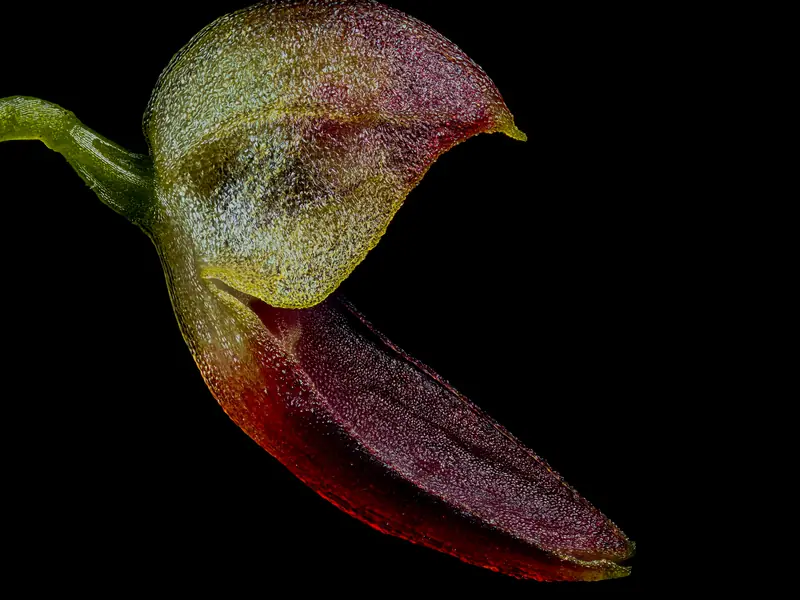
I. The Lateral View at 2.5×
The three-quarter lateral view is where I start with any orchid, because it records how the flower actually sits: the dorsal sepal hooded over the mouth, the fused lateral sepals descending into the cup, the peduncle entering the frame from below. The translucent tissue carries its red spotting, and light passing through it from behind does most of the work here. It reads as a portrait, but it is also the frame the rest of the series is read against.
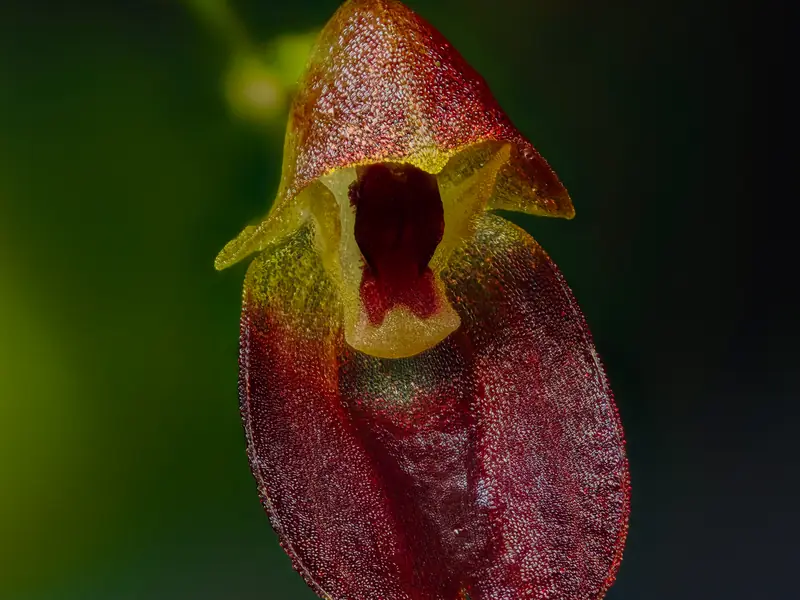
II. Face-On at 2.5×
Square to the mouth, the same flower presents its architecture: the dark opening at the centre, the small lip seated at its base, the thread-like petals flanking it, and the column tucked beneath the hood of the dorsal sepal. Nothing about the magnification changed between this frame and the lateral view; only the camera moved. That is the value of a second angle at the same scale. Posture comes from the side, architecture from the front, and the two frames compare directly in a way no single view allows. The 212-frame stack sits within a few frames of the lateral view’s, a comparable depth of capture held to the same standard.
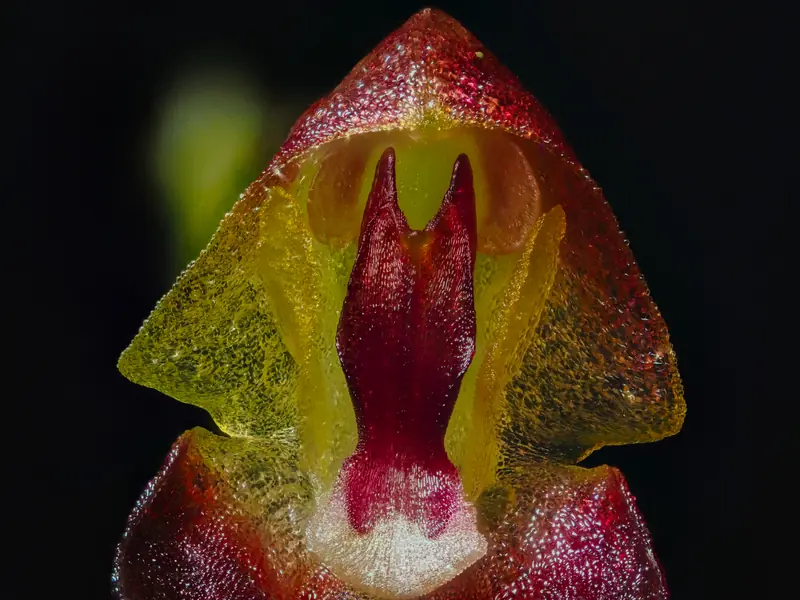
III. Inside the Mouth at ≈4.5×
At nearly twice the display magnification the frame holds only the flower’s centre, and what the face-on view could only imply becomes the subject itself: the column beneath the hood, the lip at the base of the opening, and the dark interior of the cup around them. The sharp slice of a single exposure at this power is a fraction of a millimetre deep, so this plate is assembled from 259 frames advanced along the rail in micron-scale steps. This is my favourite frame of the series, the one where the structures a pollinator would actually meet become readable at their own scale.
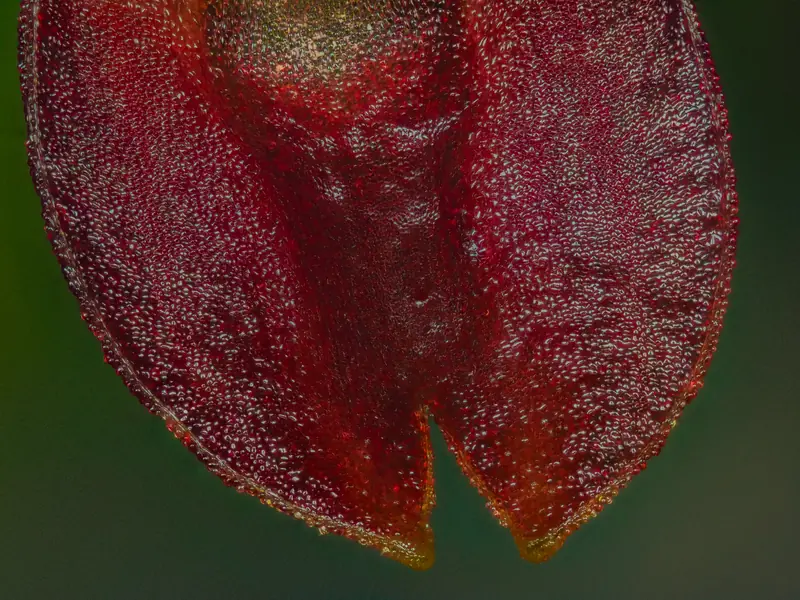
IV. The Cup Exterior at ≈4.5×
The final frame turns the same magnification on the outside of the fused lateral sepals: the lower lip of the cup, ending in the two pointed lobes with the V-shaped notch between them that is typical of the genus. This is the deepest stack of the series at 286 frames, spent on a surface that rewards it, a translucent tissue studded with fine papillae, deep red toward the margins and shading to amber at the lobe tips, with the sepal veins running through it.
How Each Image Was Built
None of these frames is a single exposure. Each is a composite merged in Zerene Stacker (PMax) from a sequence shot on the horizontal rail, the camera advancing a computed micron-scale step between frames so that every thin plane of the subject is recorded sharp somewhere in its sequence: 210, 212, 259 and 286 frames respectively. The step arithmetic behind those sequences is laid out in the rail step size note, and the reason a merged frame looks nothing like its sources is shown in the focus stacking primer.
The composites are also large. The source frames were shot in the camera’s High-Res Shot mode, so each finished master runs to 10368 × 7776 pixels, the resolution quoted on every licensing page in this series. If you have read the methods notes you may recognise this species from Note 02, which combines frames from two sessions of this same Specklinia into one stack to show what subject movement does to merged edges. That warning applies to plate IV in particular, since it was the deepest stack of the series and the one that most depended on the flower holding still.
Note 00 · What Is Macro & Focus Stacking, Exactly? →
Note 05 · Rail Step Size & Depth of Field →
Note 02 · Subject & Camera Movement (demonstrated on this species) →
The Series at a Glance
| View | Magnification | Stack depth | Catalogue |
|---|---|---|---|
| Lateral reference, three-quarter profile | 2.5× | 210 frames | JMD-ORC-015 |
| Face-on, display angle | 2.5× | 212 frames | JMD-ORC-016 |
| Mouth interior, internal view | ≈4.5× | 259 frames | JMD-ORC-017 |
| Cup exterior, lower lip | ≈4.5× | 286 frames | JMD-ORC-018 |
Any frame in this series can stand alone, whether as a manuscript figure, a teaching slide or an editorial plate. The four also work as a coordinated set, the way a type series does, with capture records and rights terms travelling with every image. A record like this is something I can put together for a specimen of your own, with the angles and magnifications planned around whatever structure you need to show.