Why One Flower Deserves Four Photographs
Morphology is three-dimensional, and a photograph is not. Any single frame of a flower is one assertion about a structure that has a front, a back, an underside and an interior, and the parts that define a Lepanthes — the fused sepals, the elaborate lip, the appendages a pollinator interacts with — do not present identically from any two of those directions. A face-on frame flatters the bloom and suits display, but it also hides whatever those structures conceal from the front. One angle is a portrait; four angles are a record.
The four composites below span this site’s working range: a display magnification of 2.5×, a bud study at 4×, and a high-magnification pass at 5×, all produced with the same camera on the same horizontal rail, each merged from a focus stack deep enough to hold its subject sharp from face to back. They can be licensed individually or as a coordinated set, and each carries its catalogue record, rights terms and a high-resolution original.
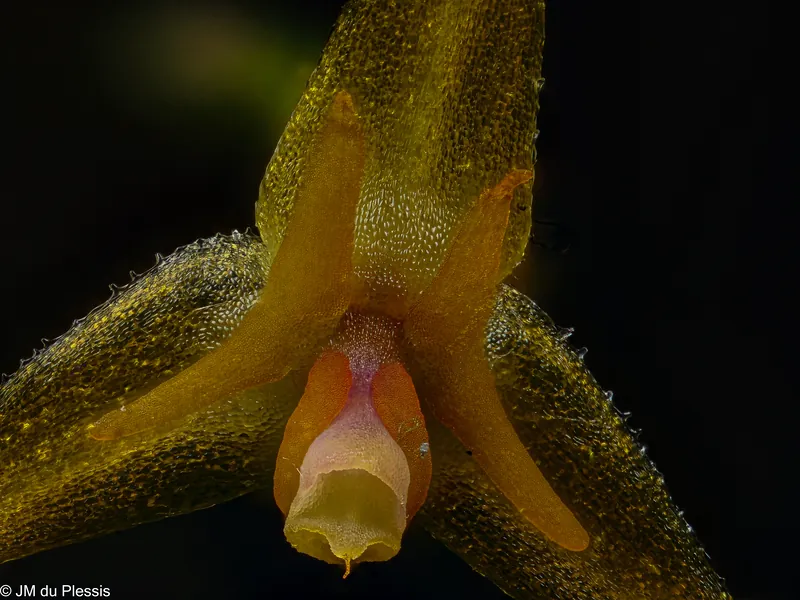
I. Face-On at 2.5× — the Display Angle
This is the presentation view: the camera square to the open flower, the translucent sepals spread wide, the lip and its appendages held at the centre of the frame. At 2.5× the whole bloom still fits with context to spare, which is why this frame — merged from 229 source exposures — is the one this site uses for display. It reads as a portrait, but it is also a measurement: the posture, symmetry and proportion of the flower exactly as it stands on the plant.
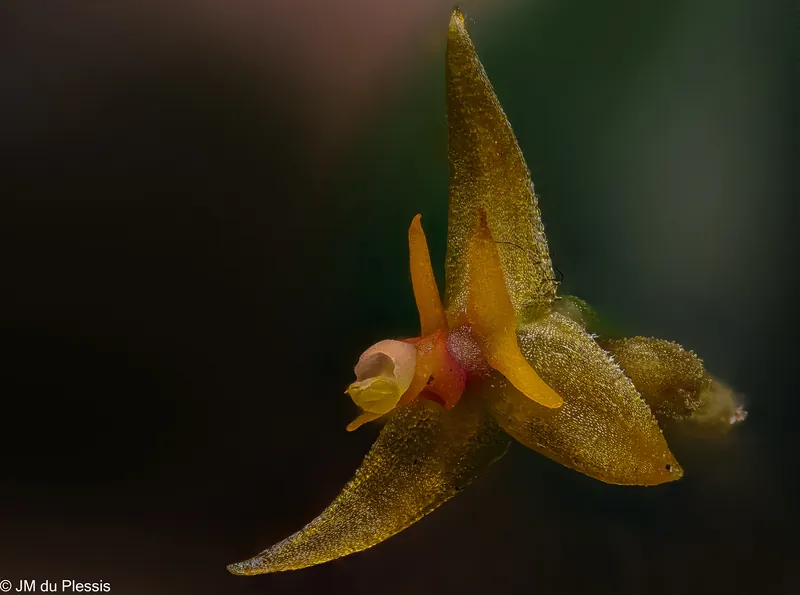
II. From Below at 2.5×
The same bloom, photographed from beneath. The wing-like fused sepals that framed the face-on view now dominate it, and the lip is read from underneath, its appendages hanging into the frame instead of presenting forward. Nothing about the magnification changed; only the camera’s position did. That is the argument for a second angle: at identical scale the two frames compare directly, and structures a frontal photograph can only imply are shown as fact. Its stack runs 212 frames against the face-on view’s 229 — a comparable depth of capture, held to the same standard of end-to-end sharpness.
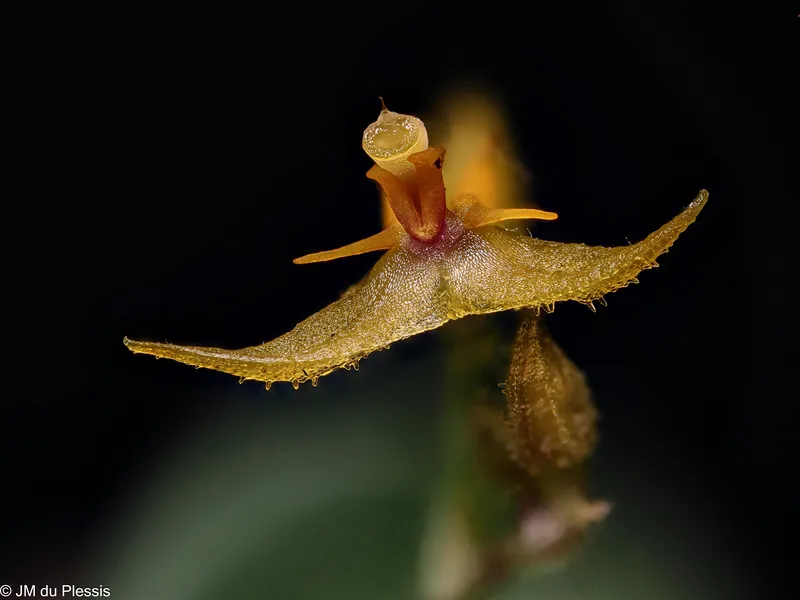
III. From Slightly Above at 5×
The third frame moves the camera just above the flower and doubles the magnification. At 5× the sharp slice of any single exposure collapses to a fraction of a millimetre — thinner than a sheet of paper — so this composite is again assembled from 217 frames advanced along the rail in micron-scale steps. What the extra power buys is surface: the texture of the sepals and the architecture of the lip resolve at a level of detail the 2.5× frames carry only as suggestion.
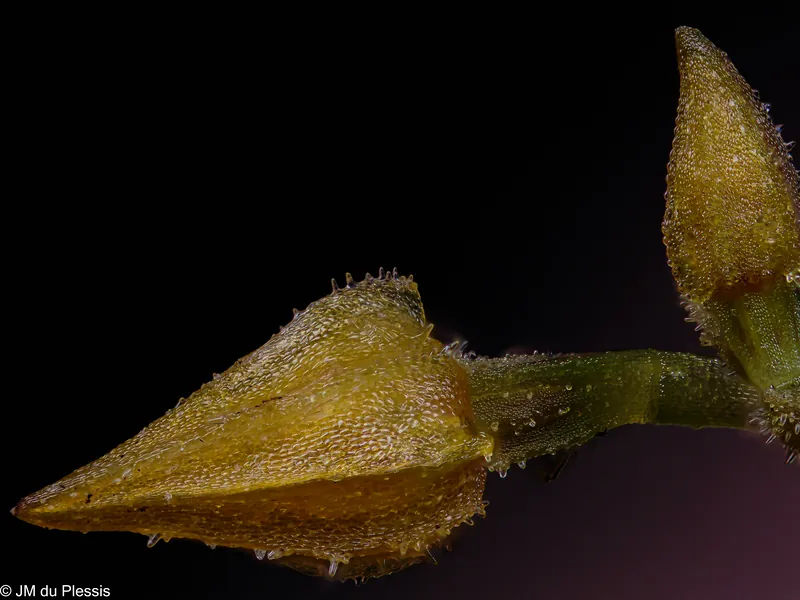
IV. The Bud at 4×
Before anthesis, the same structures exist in a different geometry: sepals and lip folded around each other, the architecture of the open flower already present but closed. This 4× study — a shallower stack of 78 frames for a shallower subject — documents the developmental stage rather than the presentation. For morphological work the pairing of bud and bloom is not decorative; it is evidence of how the one becomes the other.
How Each Image Was Built
None of these frames is a single exposure. Each is a composite assembled in stacking software from a sequence shot on the horizontal rail, the camera advancing a computed step between frames so that every thin slice of the subject is recorded sharp somewhere in the sequence. The step is set deliberately — a fraction of the measured depth of field — and the arithmetic behind it is laid out in full in the rail step size note.
What the raw material looks like is shown elsewhere on this site. The homepage’s client-proof section walks through three successive source frames of the 78-frame bud stack, and Note 00 does the same for the 217-frame 5× stack: single exposures in which only one thin plane of the flower is sharp, each unremarkable on its own. The composites in this series are what those frames become when dozens or hundreds of them are merged.
Note 00 — What Is Macro & Focus Stacking, Exactly? →
Note 05 — Rail Step Size & Depth of Field →
See the source-frame walkthrough on the homepage →
The Series at a Glance
| View | Magnification | Stack depth | Catalogue |
|---|---|---|---|
| Face-on, display angle | 2.5× | 229 frames | JMD-ORC-002 |
| From below | 2.5× | 212 frames | JMD-ORC-003 |
| From slightly above | 5× | 217 frames | JMD-ORC-004 |
| Bud, pre-anthesis | 4× | 78 frames | JMD-ORC-001 |
Any frame in this series can stand alone — a manuscript figure, a teaching slide, an editorial plate. The four also work as a coordinated set, the way a type series does. Rights terms and capture records travel with every image.